
Meta Ads Ruben·Social Ads specialist
Meta AI can now analyse your ads: what it means for your SMB account
Ruben·Social Ads specialist Google Premier Partner
 Meta Business Partner
The 20% budget rule for the learning phase in Meta Ads does not officially exist. What Meta actually requires, and how to scale without worrying about resets.

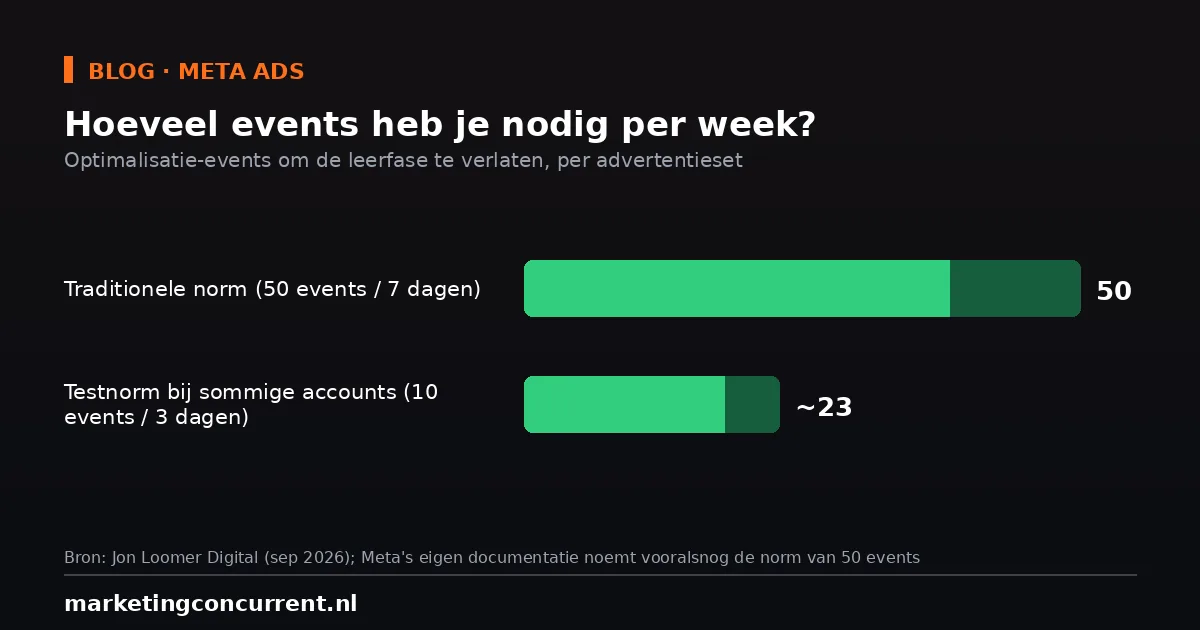
A handful of rules of thumb circulate around the learning phase in Meta Ads that are repeated so often they feel like fact. The main one says that a budget change of more than 20 percent always resets your learning phase, so whatever you do, do not increase your budget too quickly. That 20 percent appears nowhere in Meta's own documentation. What Meta does confirm is that an ad set typically needs around 50 optimisation events in seven days to leave the learning phase, and that "significant" changes to targeting, optimisation goal or bid strategy can reset that clock. The difference between those two statements is bigger than it looks, and it decides whether or not you can touch your budget tomorrow.
For SMB accounts with a modest budget, this is more than a technical detail. Those who never scale for fear of a reset leave growth on the table. Those who scale without any awareness can indeed land in a new learning phase with temporarily higher costs. It is one of the first things we check when we take on Meta advertising for a client. Below are three myths that get in the way of that balance, and what is actually true instead.
This is the most common misconception, and also the most paralysing. Advertisers who believe it sometimes leave underperforming ads running for weeks out of fear of "breaking" something. In reality, Meta distinguishes between minor and significant changes. Changing your audience, your optimisation goal or your bid strategy counts as significant and can restart the learning phase. Pausing an ad set for more than seven days and then resuming it does the same. Switching off an individual ad within a set, or adding a new ad to an existing set, is not experienced as a hard reset by most seasoned media buyers, although this remains one of the points where Meta itself provides no definitive list.
In practice, you do not have to leave a poorly performing ad in place until the end of time. Switch it off, add a new variant, and leave the rest of the set alone. That is a very different risk from overhauling your entire audience.
The 20 percent rule shows up in almost every Dutch and English-language guide to Meta Ads, usually without a source. Research into Meta's own help documentation shows that the company publishes no fixed percentage. What it does say is that budget and bid changes have to be "significant" to affect the learning phase, without attaching a number to that.
The learning phase label says something about the system, not automatically something about your results. Look at your cost per lead, not at the label.
That does not make caution unnecessary. Large, sudden jumps in budget force the algorithm to relearn which audience segments perform best anyway, even without an official threshold being crossed. What we often see with advertisers is that a gradual increase in steps spread over a few days runs more smoothly than one big jump, purely because the delivery system then has less to recalculate at once. But that is a practical rule of thumb, not a hard Meta rule, and certainly no reason to postpone a much-needed budget increase for months.
When setting up campaigns, the temptation is to create a separate ad set for every audience, every country or every interest. Each set then has to work its way towards those 50 events per week on its own. Spread a budget of 2,000 euros per month across eight ad sets and each set might get 250 euros and a handful of conversions. No set ever leaves the learning phase, with erratic, expensive results as a consequence.
Combining audiences into fewer, broader ad sets, or switching to campaign-level budget allocation where Meta itself shifts spend between sets, usually means enough events per set come in faster. Fewer sets with more volume typically leave the learning phase sooner than many sets with too little data.
For a subset of accounts, Meta is testing a shorter benchmark. Instead of 50 events in seven days, 10 events in three days would be sufficient, which works out to roughly 23 events over a week. This is not a global rollout, and Meta's own documentation still cites the old benchmark of 50 events per seven days for now. So do not assume this already applies to your account, but do not be surprised if your account shows a lower number than you were used to. It fits a broader shift in which Meta leaves more and more to the system, as with the removal of placement exclusions from your ad sets.
Not sure whether your Meta account is ready to scale? Book a strategy call and a senior strategist will review it with you beforehand.
The guideline Meta itself uses is around 50 optimisation events per ad set within seven days. For a subset of accounts, Meta is testing a lower benchmark, but this is not a fixed rule for everyone and can differ per account.
Not by definition. If the cost per result is acceptable, there is little reason to intervene. The learning phase label says something about how much the system is still learning, not automatically that you are wasting money.
No, that is not necessary. A budget increase can happen at any time, including during the learning phase. Do it gradually for campaigns that are already running, so the delivery system does not have to revalidate a large part of its accumulated knowledge all at once.
Builds and optimises Meta and TikTok campaigns every day and tests what creatives, placements and the learning phase really do. Questions about this article? Book a strategy call or meet the whole team.
Ruben·Social Ads specialist Ruben·Social Ads specialist
 Ruben·Social Ads specialist