AI & strategy Arjan·Managing Director
Why your AI chatbot frustrates customers more often than it helps
Arjan·Managing Director Google Premier Partner
 Meta Business Partner
The transparency obligation in the EU AI Act has applied since 2 August. Check these 5 points to make sure your SME stays on the right side of the law.
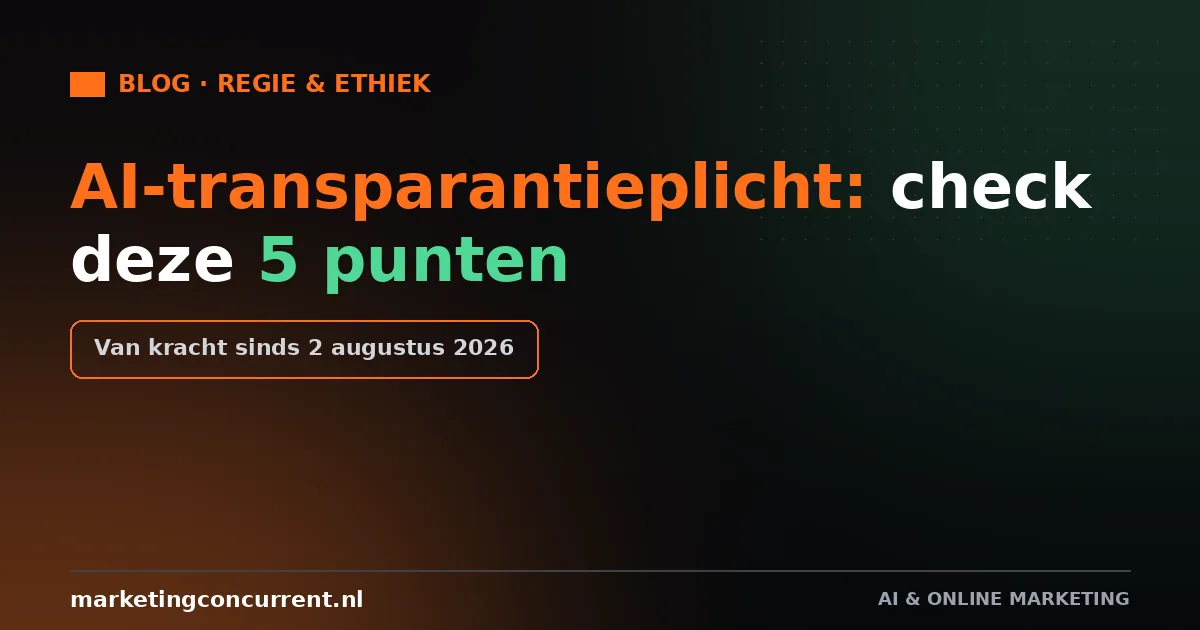
Since 2 August, the transparency obligation in the European AI Act has applied in practice. Do you have a chatbot on your website, do you use AI for customer contact, or do you have images, video or text generated automatically? Then there are a number of things you need to have in order. In the Netherlands, the Dutch Data Protection Authority (Autoriteit Persoonsgegevens) confirmed in mid-July that the rules were taking effect and advised companies to sign the European Commission's voluntary code of practice. A month on, it turns out that many business owners simply let that deadline pass, usually because they did not know the law also applies to a small chatbot on an online shop. This article walks through what exactly is required, what you can still put right this week and roughly what it will cost.
Article 50 of the AI Act does not regulate whether you may use AI, which you simply may, but whether you are open about it. The Dutch Data Protection Authority lists four situations in which you have to disclose or label something. If a visitor talks to a system driven by AI, it must be clear to that person that it is not a human. If you use AI to recognise emotions or to categorise people based on biometric characteristics, you disclose that in advance. If you have audio, images, video or text generated automatically, that synthetic content must be recognisable, for example with a watermark or label. And if you create or distribute a deepfake, you indicate visibly or audibly that it was made or edited with AI.
For most SMEs, the first point is the one that bites: the chatbot on the website or in the customer service app.
A compliance project does not have to take months. These five points cover most of what an average SME needs to arrange.
Coding Agency, a knowledge centre specialising in AI regulation, cites fines of up to 15 million euros or 3 percent of global annual turnover for breaches of Article 50, whichever is higher. That sounds alarming for a company with ten employees. In practice, enforcement focuses mainly on the providers of AI models themselves, such as OpenAI, Google and Anthropic, and on large parties deploying AI at scale without any form of transparency. For smaller businesses the penalty rules include a softening, where the lower of the two maximum amounts applies instead of the higher.
A common misconception is that all AI-written text has to be labelled. That is not quite right. The labelling requirement for text mainly applies to content on matters of public interest that has not been through editorial review. A product description or blog article that you have reviewed and edited yourself generally falls outside it. What we often see among business owners is that they get needlessly nervous about precisely this point while forgetting the chatbot notice, when it really should be the other way round.
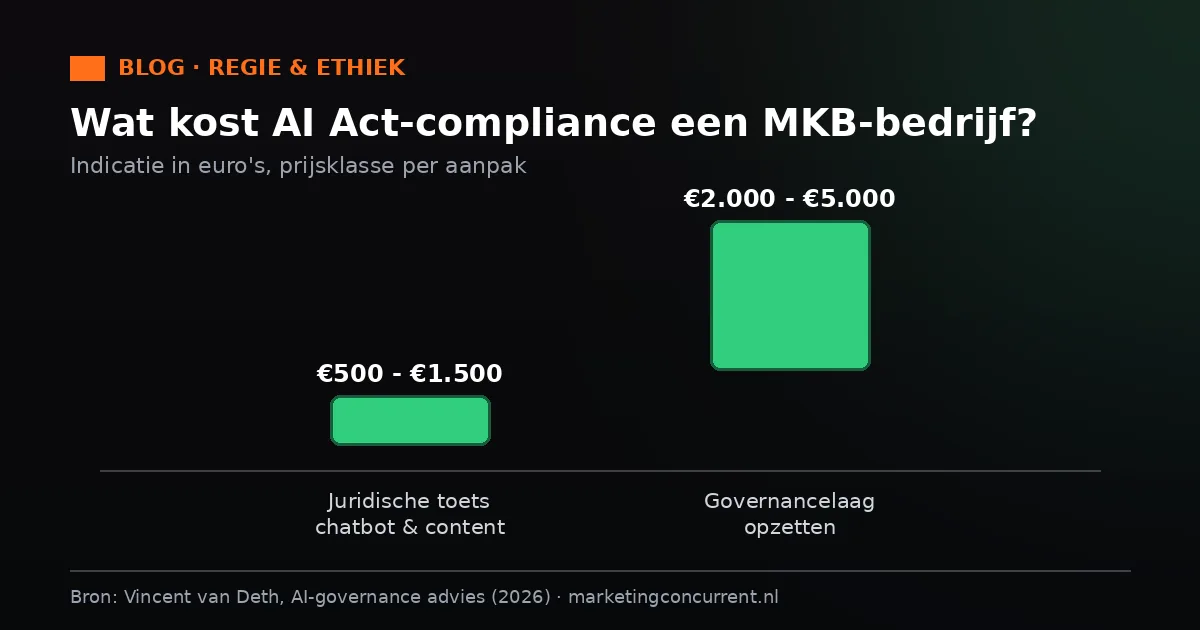
For an average SME, this does not need to be a significant expense. AI governance adviser Vincent van Deth puts a legal review of your chatbot and content process at between 500 and 1,500 euros with a specialised firm, depending on how many AI applications you have. If you want to set up a sturdier governance layer, with a fixed process for new AI tools and a designated owner, you are looking at something closer to 2,000 to 5,000 euros. A standard such as ISO/IEC 42001 can help to get processes in order, but does not count as legal proof of compliance. See it as a tool, not a substitute for the law itself.
A chatbot that stays silent about being a chatbot has simply been breaking the law since 2 August. Put one sentence above the chat and the problem is solved.
Yes. If the system responds automatically and it is not immediately obvious that it is not a human, you have to disclose that. A simple line at the top of the chat window is enough; you do not need to build a separate page for it.
In most cases, no. The labelling requirement for text is mainly intended for unedited content on matters of public interest. A blog article you have checked and edited generally falls outside it. If you are unsure about your specific situation, seek targeted legal advice. This article is meant as a practical guide and is not legal advice, and the interpretation of "public interest" can differ from case to case.
No separate new supervisory authority has been created. According to Coding Agency, a group of ten sectoral regulators in the Netherlands deals with this, with the Dutch Data Protection Authority in a coordinating role. For most SMEs this mainly means that an inspection may follow a complaint or a spot check, not that checks take place daily.
Founder and managing director of MarketingConcurrent, building AI tooling for marketing and e-commerce with AIbove and DropMetrics. Questions about this article? Book a strategy call or meet the whole team.
Arjan·Managing Director